
Mathieu's 5 thoughts on design
Mathieu's 5 thoughts on design
After years of working in an agency setting, I prefer to work as a freelancer now. I have reached a point to where I didn’t see how I could fit in, and that says something more about the room, than about me.
After years of working in an agency setting, I prefer to work as a freelancer now. I have reached a point to where I didn’t see how I could fit in, and that says something more about the room, than about me.
Where a team lacks a person of color, it is often not malice, just ignorance. Or something a company deliberately does, when let’s say there are 20 people working there and not one person of color is represented. I mean come on...?!
Where a team lacks a person of color, it is often not malice, just ignorance. Or something a company deliberately does, when let’s say there are 20 people working there and not one person of color is represented. I mean come on...?!
When I show my portfolio, people still ask if I really made it myself. I have learned to explain it twice, just to be believed once. And even then, I have a feeling they don’t believe it, and then imposter syndrome kicks in.
When I show my portfolio, people still ask if I really made it myself. I have learned to explain it twice, just to be believed once. And even then, I have a feeling they don’t believe it, and then imposter syndrome kicks in.
In my cover letters I state, on purpose, that I am a person of color. It holds up a mirror: look how homogeneous your team really is.
In my cover letters I state, on purpose, that I am a person of color. It holds up a mirror: look how homogeneous your team really is.
I want a place where people can honestly say what it was like to work somewhere, especially when it came down to how they were seen.
I want a place where people can honestly say what it was like to work somewhere, especially when it came down to how they were seen.
Want to know more or connect? Continue for the full article below
The full article
The full article
Finding Rotterdam
At a young age Mathieu was adopted by his parents, while they were residing in Indonesia, and he grew up traveling around the world due to his father’s work. He went to international schools until he spent his young adult years in Delft. He then went on studying graphic design at the Willem de Kooning Academy, and eventually found his own place in Rotterdam, feeling at home by people who (finally) looked like him. It was a small shift with a lasting effect, the kind that that made him look differently at how businesses and workplaces are set up.
At a young age Mathieu was adopted by his parents, while they were residing in Indonesia, and he grew up traveling around the world due to his father’s work. He went to international schools until he spent his young adult years in Delft. He then went on studying graphic design at the Willem de Kooning Academy, and eventually found his own place in Rotterdam, feeling at home by people who (finally) looked like him. It was a small shift with a lasting effect, the kind that that made him look differently at how businesses and workplaces are set up.
Being the difference
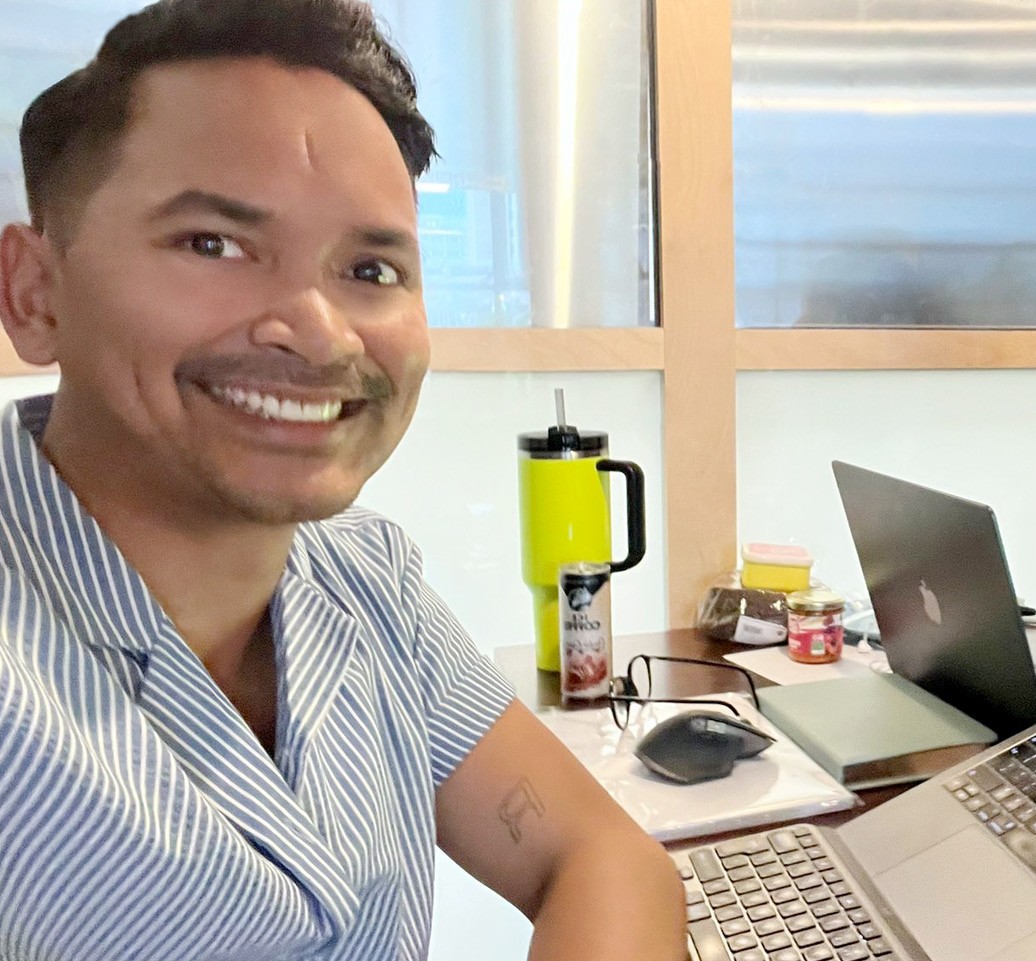
Currently, Mathieu works as a freelancer in graphic design, taking on projects that range from campaigns to working on local projects for his own neighborhood, alongside some photography work. Before this, he worked within agencies, where he had already started noticing something. When a design team creates an icon set or a visual identity that includes human figures, the default is often, without anyone quite realizing it, a lack of people of color. That default is already a choice in itself. It rarely comes from bad intention, he says. The perspective has simply never been raised, or never been brought to light this way. He sees pointing it out not as a burden he carries but as something he adds, questioning defaults as they come up: "What is a normal skin color? Define that for me."
Currently, Mathieu works as a freelancer in graphic design, taking on projects that range from campaigns to working on local projects for his own neighborhood, alongside some photography work. Before this, he worked within agencies, where he had already started noticing something. When a design team creates an icon set or a visual identity that includes human figures, the default is often, without anyone quite realizing it, a lack of people of color. That default is already a choice in itself. It rarely comes from bad intention, he says. The perspective has simply never been raised, or never been brought to light this way. He sees pointing it out not as a burden he carries but as something he adds, questioning defaults as they come up: "What is a normal skin color? Define that for me."

Noticing patterns
That same attentiveness has made him sharply aware of patterns in the design field itself, in e.g. who gets hired and who does not. His own portfolio has been questioned more than once. "Did you really make this yourself?" is a question he has learned to expect and answering it is rarely enough the first time. "I had to explain it twice, just to be believed once," he says. It has changed how he approaches job hunting. Before applying anywhere, he now looks first at who already works there, treating the makeup of a team as information.
That same attentiveness has made him sharply aware of patterns in the design field itself, in e.g. who gets hired and who does not. His own portfolio has been questioned more than once. "Did you really make this yourself?" is a question he has learned to expect and answering it is rarely enough the first time. "I had to explain it twice, just to be believed once," he says. It has changed how he approaches job hunting. Before applying anywhere, he now looks first at who already works there, treating the makeup of a team as information.
Holding up a mirror
Mathieu is both critical and fascinated by how representation of people of color often shows up in advertising, sometimes feeling more like a checkbox than a real choice. But he does have an example of a company that, according to him, does this well: Apple. Their ads consistently feature people of color in ways that feel natural rather than staged, people of color are present without needing an explanation. It is proof, to Mathieu, that authentic representation is possible when it is not treated as a quota. That same instinct for using his voice runs through how he applies for work. In his cover letters, he states directly that he is a person of color, a line meant to hold up a mirror before a company even meets him, a small signal of just how homogeneous their team might actually be. To the next generation designers, his message is direct. The fight to be seen for who you are never really ends, so you might as well take it on.
Mathieu is both critical and fascinated by how representation of people of color often shows up in advertising, sometimes feeling more like a checkbox than a real choice. But he does have an example of a company that, according to him, does this well: Apple. Their ads consistently feature people of color in ways that feel natural rather than staged, people of color are present without needing an explanation. It is proof, to Mathieu, that authentic representation is possible when it is not treated as a quota. That same instinct for using his voice runs through how he applies for work. In his cover letters, he states directly that he is a person of color, a line meant to hold up a mirror before a company even meets him, a small signal of just how homogeneous their team might actually be. To the next generation designers, his message is direct. The fight to be seen for who you are never really ends, so you might as well take it on.
Connect or follow up with
Mathieu
This article was published on
Designers in Full Color - All rights reserved 2026
Designers in Full Color - All rights reserved 2026
Designers in Full Color - All rights reserved 2026